Posts

Showing posts with the label Data Store

Definition Related to DFD

     A Data Flow Diagram is a network model of an information processing system. The arcs of the network represent data flows, and the nodes represent data stores, transforms, or selected elements of the environment. A Data Flow is a movement of information within the system or across the system boundary. A data flow which crosses the system boundary to enter the system is called a net system input  or simply System Input .  A data flow which crosses the boundary to leave the system is called a net system output or System Output . A Data Store is a time-delayed repository of information, where data is kept temporarily or permanently, avoid thinking of them in computer "file" terms, there are many quite different forms. A Process , or Transform , is a transformation that inputs one type of data and outputs a different type. It is a conversion of data from one form to another. A process cannot output data without ge...
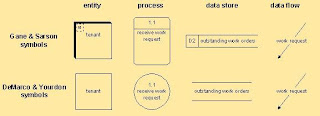
Symbol Used In Data Flow Diagram (DFD)

Image
Entities: can be people, departments, other companies, other systems… are called sources if they are external to the system and provide data to the system, and sinks if they are external to the system and receive information from the system Processes must have at least one input and at least one output at the primitive level (see below) are labeled with verb + object (e.g. “print invoice” or “add customer”) (e.g. in the hierarchy below, none of the processes are primitive) at the non-primitive level, are labeled more generally (e.g. “customer maintenance” or “warehouse reports”) Data stores: · can be online or “hard copy” (see notes on logical VS physical DFD’s below) · are labeled with a noun (e.g. the label “customer” indicates that information about customers is kept in that data store) · data is stored whenever there are more than one process that needs it and these processes don’t always...